Free Tool · No Signup
Material Calculator: How Much Do You Need?
Estimate gravel, rock, sand, base, or soil in seconds. Enter length, width, and depth. We return cubic yards, tons, and coverage so you can order the right tonnage the first time.
Estimate gravel, rock, sand, base, or soil in seconds. Enter length, width, and depth. We return cubic yards, tons, and coverage so you can order the right tonnage the first time.
Tonnage math usually decides whether an install runs smooth or stalls. Order too little and the crew waits a day for a second delivery. Order way too much and the leftover pile sits in the driveway while the neighbor starts asking questions. This tool gets you to the right number.
All the common Las Vegas materials are preloaded with accurate density values: decorative rock, pea gravel, DG, Type II base, washed sand, soil blends. Enter dimensions, pick a depth, and we convert straight to tons delivered. Add about 10 percent for compaction and waste when you place the order.
Enter dimensions and depth. We estimate cubic yards, tons, and coverage in real time. Add 10% when ordering for compaction, waste, and settling.
Most residents spend under a minute on this. Here is what each field wants from you.
Pick the category that matches your project: landscape rock, construction base, sand and soil. Densities differ, so the tonnage math shifts with the category.
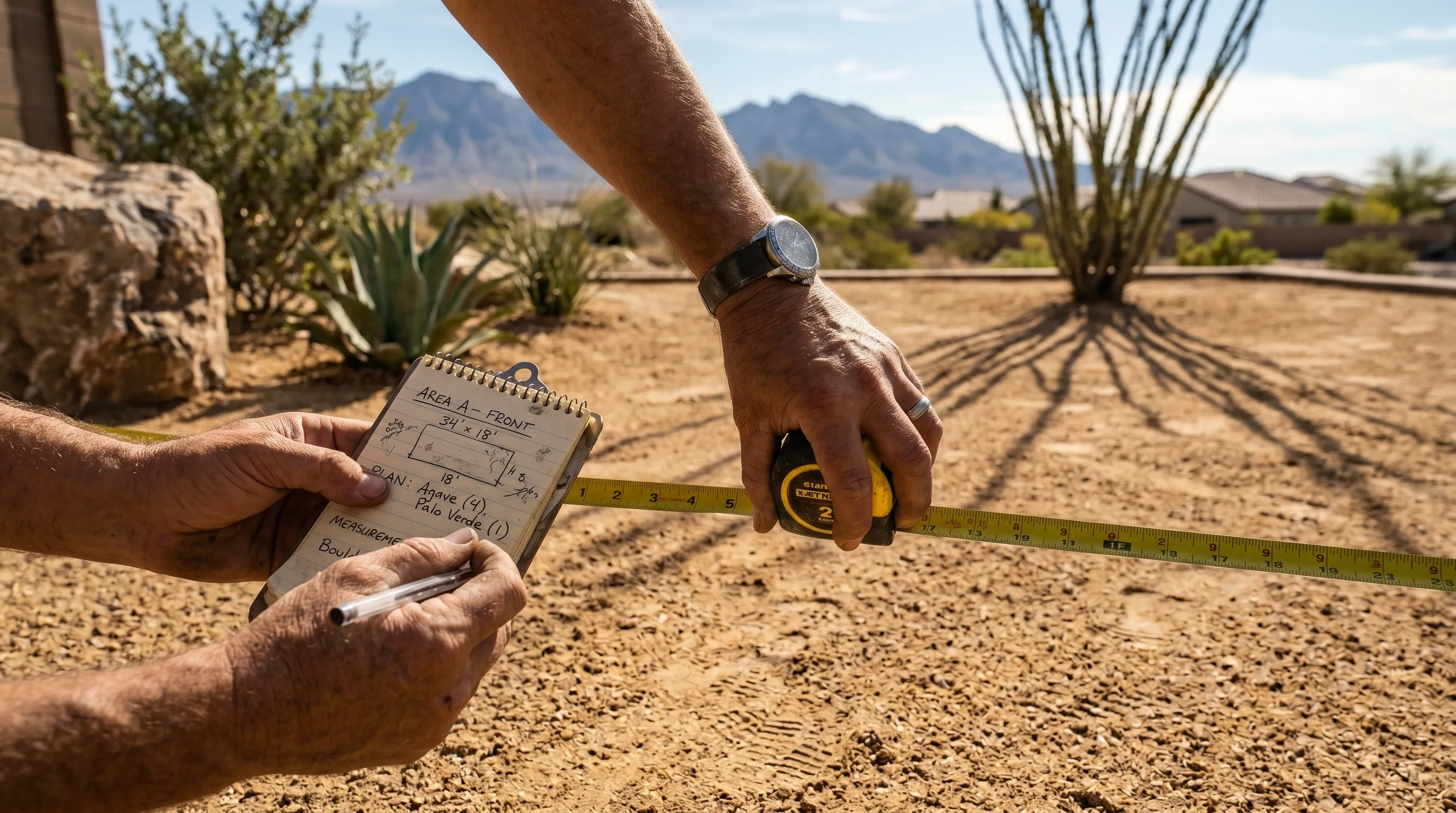
Measure the area in feet. For a 20 ft by 15 ft patio, enter 20 and 15. For odd shapes, use the biggest rectangle the area fits inside, then round up.
Most decorative rock goes 2 to 3 inches. Driveway base runs 4 to 6 inches. Sand bedding sits at 1 inch. Pick the depth and we do the conversion.
Square footage per ton at common depths. Use this as a sanity check against what the calculator returns.
| Material | At 1" Depth | At 2" Depth | At 4" Depth |
|---|---|---|---|
| Decorative Rock (1/2" to 1.5") | ~215 sq ft | ~110 sq ft | ~55 sq ft |
| Pea Gravel | ~225 sq ft | ~110 sq ft | ~55 sq ft |
| Decomposed Granite | ~240 sq ft | ~120 sq ft | ~60 sq ft |
| Type II Base | ~200 sq ft | ~100 sq ft | ~50 sq ft |
| Washed Sand | ~240 sq ft | ~120 sq ft | ~60 sq ft |
| Topsoil Blend | ~295 sq ft | ~145 sq ft | ~75 sq ft |
Coverage varies with gradation and moisture. Add 10 percent for compaction and waste. For projects above 100 tons call (702) 597-1010 for a custom quote.
Short version: match the material to the job, then size the depth to the traffic and compaction load.
Works for SNWA turf conversion, front-yard xeriscape, garden borders. Most Las Vegas residents go 2 to 3 inches deep across the whole bed. Browse Brown Rock, Red Rock, Silver Frost, or Rose Rock on the Landscape Materials hub.
Type II base goes under residential driveways at 4 to 6 inches compacted, and under commercial pads per the engineer's spec. Use "Construction & Base" in the calculator for Type II gradation.
Fill dirt and pit run handle elevation changes, pad prep, bulk grading. Depth varies by project. Clean fill is required for most utility trench and foundation backfill.
Washed sand in concrete sand, plaster, or mason grades. Sand bed under a slab is typically 1 inch. Stucco scratch and brown coats use different sand grades.
3/4 inch drain rock in a trench over filter fabric and perforated pipe. Rule of thumb: 1 to 3 tons per 10 linear feet depending on trench size. Calculate as "Construction".
Paver base aggregate 4 inches deep plus 1 inch of bedding sand. The calculator handles both. Use "Construction & Base" for the base layer and "Sand & Soil" for the bedding layer.
Click the quote button below the calculator and your estimate carries into the request form. We will call you with a quote and schedule delivery, usually within 2 to 5 business days.